Guide
Ready to try your Chinese keyboard?
Start with a short HSK 1 typing session. No signup is required.
Practice HSK 1 vocabularyIf you're setting up Chinese input on your computer, one of the first decisions you'll hit is: Simplified or Traditional? Your operating system may ask you to pick a Chinese keyboard, and typing practice sites ask you to choose a character set.
This is not only a language-learning question. It is a practical typing decision: who you write to, which input method you use, and what kind of text you want to practice.
| Your goal | Start with |
|---|---|
| Learning Mandarin with mainland Chinese textbooks or apps | Simplified Chinese |
| Communicating with people in mainland China, Singapore, or Malaysia | Simplified Chinese |
| Reading or writing for Taiwan | Traditional Chinese |
| Reading or writing for Hong Kong or Macau | Traditional Chinese |
| Learning Cantonese typing | Traditional Chinese |
| Practicing Cangjie or Zhuyin | Traditional Chinese |
| Practicing Pinyin for modern Mandarin | Usually Simplified, unless your audience uses Traditional |
| Unsure and just want the widest beginner path | Simplified Chinese |
If you already have a real audience, follow that audience. If your family, class, workplace, or customers use Traditional Chinese, practice Traditional. If your materials and contacts are mainland-oriented, practice Simplified.
Chinese characters exist in two main written forms:
The spoken language and grammar are not determined by the character set. Mandarin can be written in Simplified or Traditional characters. Cantonese is usually written in Traditional characters, especially in Hong Kong.
Also, not every character changes. Many common characters are identical in both systems, including 人, 大, 中, 一, 我, and 你.
Simplified Chinese is the standard written form in:
If you are learning Mandarin for travel, mainland media, business in mainland China, or general beginner coursework, Simplified is usually the default.
Traditional Chinese is the standard written form in:
If you read Taiwanese media, work with Hong Kong clients, study Cantonese, use Zhuyin, or want to type Cangjie, Traditional is usually the right place to start.
Use this order of priority:
For example, a Mandarin learner using mainland textbooks should probably practice Simplified Pinyin. A Hong Kong office worker should probably practice Traditional Chinese with Cangjie or another local input method. A Taiwan learner should probably practice Traditional Chinese with Zhuyin or Traditional Pinyin output.
There is no moral hierarchy here. Both systems are real Chinese. The useful question is: which one will make your daily typing more fluent?
If you are still undecided, make a temporary choice instead of waiting for a perfect one: use Simplified for seven days if your course uses Pinyin and mainland-oriented materials, or Traditional for seven days if your real goal is Taiwan, Hong Kong, Zhuyin, or Cangjie. A week of actual typing will reveal more than comparing character lists indefinitely.
Your input method and your character set are related, but they are not the same thing.
| Input method | Common output | Good for |
|---|---|---|
| Pinyin | Simplified or Traditional | Mandarin learners, mainland Chinese, general typing |
| Zhuyin / Bopomofo | Traditional | Taiwan-focused typing |
| Cangjie | Traditional | Hong Kong, Traditional Chinese, shape-based typing |
| Quick / Sucheng | Traditional | Hong Kong users who want a lighter Cangjie-like method |
| Wubi | Simplified | Mainland users who want shape-based typing |
Pinyin can output either Simplified or Traditional characters depending on your keyboard settings. That means you can type xue and choose 学 or 學 if your system supports both outputs.
Zhuyin and Cangjie are more naturally connected to Traditional Chinese. Wubi is more naturally connected to Simplified Chinese.
You can learn both character sets, and many literate Chinese readers can recognize both even if they mainly write one. But for typing practice, it is usually better to focus on one at a time.
Typing is partly recognition, partly keyboard muscle memory, and partly candidate selection. Switching character sets too early can make all three feel slower.
A practical sequence:
This keeps your typing fluency from becoming a constant context switch.
If you choose Simplified Chinese, start with high-frequency material:
If you choose Traditional Chinese, start with the same structure:
For beginners, common-character drills are useful because you repeatedly see the highest-frequency characters. Once you can type those without stopping every few seconds, newspaper passages are better because they train flow.
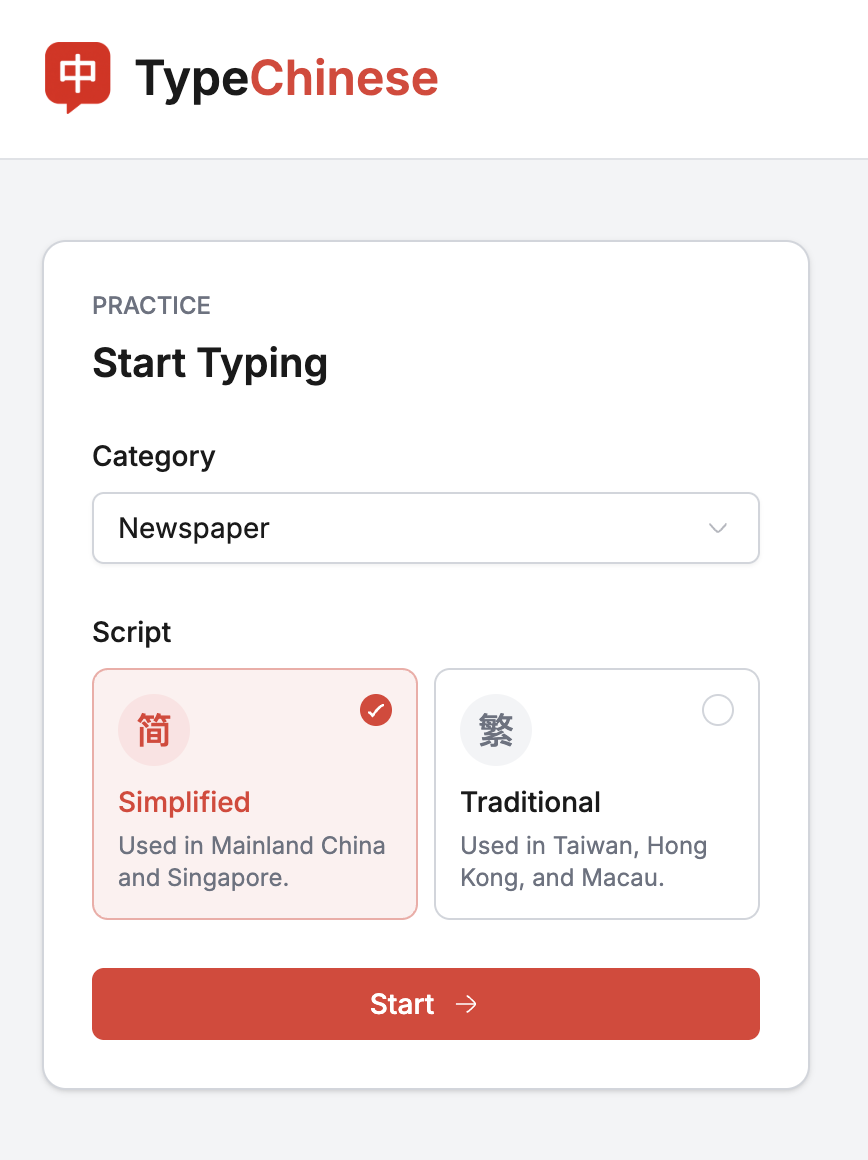
On TypeChinese, category and script are separate choices: you can practice the same kind of material in either Simplified or Traditional Chinese.
Simplified characters often have fewer strokes, but that does not automatically make them easier to type. If you use Pinyin, you type pronunciation, not strokes. If you use Cangjie or Wubi, the shape matters more.
Choose based on audience and input method, not just visual complexity.
Typing speed improves fastest when practice resembles your real use. If you write emails and documents, practice standard sentences and news-like prose. If you chat with family in Taiwan, practice Traditional conversational and media text. If you work with mainland Chinese materials, practice Simplified modern prose.
It is tempting to practice both every day, but early typing skill benefits from consistency. Pick one primary mode for a few weeks. Add the other later.
TypeChinese supports both Simplified and Traditional Chinese practice. The site has practice material across common characters, newspaper passages, children's books, and classic literature, with helper hints that match the text you are typing.
A good first-week plan:
| Day | Practice |
|---|---|
| 1-2 | Common-character drills in your chosen character set |
| 3-4 | Short passages with hints enabled |
| 5-6 | Newspaper passages, focusing on accuracy |
| 7 | Repeat one passage and compare how smooth it feels |
You do not need to solve Simplified vs Traditional forever before you start. Pick the one your current audience needs, practice consistently, and add the other later when your first typing habit is stable.