Guide
Start with a 3-minute Cangjie drill
Practice Traditional common characters with Cangjie hints already selected, then come back to the guide when a character gets stuck.
Practice with Cangjie hintsCangjie is different from Pinyin and Zhuyin in one important way: it does not depend on pronunciation. It depends on character shape. You look at a Chinese character, break it into basic components, match those components to letters on the keyboard, and type the character from its structure.
That makes Cangjie harder at the beginning, but it has several clear advantages once you learn it:
If you want to learn Cangjie, the most important thing is not memorizing the full root chart in one sitting. It is building a practice routine you can actually keep. This guide covers roots, decomposition, common mistakes, and a practical learning path.
If you want to start right now, open Traditional common character practice and practice for 3 minutes. The page will preselect Cangjie hints; when a character gets stuck, come back to the decomposition notes below.
Different learners should start in different places. Pick the situation closest to yours:
| Your situation | Recommended start |
|---|---|
| You have never learned Cangjie | Practice Traditional common characters with Cangjie hints on. Do not rush to memorize the full root chart. |
| You study or work in Hong Kong | Learn the difference between Cangjie and Sucheng, then practice with real Traditional Chinese text. |
| You know some roots but often get stuck | Use common character practice to fill gaps, and write down 5 stuck characters each session. |
| You can already type short words | Move into children's stories or newspaper passages to build continuous typing rhythm. |
| You just want to look up a character code | Guess once first, then use hints to confirm instead of only copying the answer. |
If you are not sure where to begin, choose the first path: common characters + Cangjie hints + 3 minutes. That will stick better than reading every rule once.
The Cangjie input method was invented by Chu Bong-Foo in 1976 and named after Cangjie, the legendary creator of Chinese characters.
The core idea is simple:
For example, 明 can be decomposed into 日 and 月. In Cangjie, 日 maps to A and 月 maps to B, so 明 is AB.
Cangjie can look like memorizing secret codes at first, but once you become fluent, you do not think through every rule character by character. Common characters become muscle memory, much like English typing.
Cangjie is not necessary for everyone. Use this table to decide whether it fits you:
| Situation | Recommendation |
|---|---|
| You mainly type Traditional Chinese | Cangjie is worth considering. |
| You study or work in Hong Kong | Cangjie is very practical. |
| You often meet characters you cannot pronounce | Cangjie has an advantage over Pinyin. |
| You only type Chinese occasionally | Pinyin or Zhuyin may be easier. |
| You are willing to practice for 4-8 weeks | Cangjie can start paying off. |
If you need to type Chinese today with the least friction, Cangjie is not the fastest starting point. If you want a long-term, stable input method for Traditional Chinese, it is worth learning.
Cangjie has many roots, but beginners should not start by force-memorizing all of them. Start with the most common and intuitive roots.
| Key | Root | Common components | Memory cue |
|---|---|---|---|
| A | 日 | 日, 曰 | Sun or day shape |
| B | 月 | 月, 目, flesh radical | Moon and body parts |
| C | 金 | 金, 八 | Metal and divided shapes |
| D | 木 | 木, 禾 | Wood and tree shapes |
| E | 水 | 水, 氵 | Water components |
| F | 火 | 火, 灬 | Fire and four-dot bottom |
| G | 土 | 土, 士 | Earth or ground |
| H | 竹 | 竹, ⺮, slanting stroke | Bamboo top and diagonal shapes |
| I | 戈 | 戈, 弋, 丶 | Spear shape and dot |
| O | 人 | 人, 亻 | Person components |
These 10 roots appear again and again in common characters. Getting them into your hands is more useful than staring at the full chart ten times.
Try this: open common character practice and look for characters that contain 日, 月, 人, 木, or 水. Guess the key first, then check the hint.
After the first 10 roots feel familiar, use the full alphabet chart as a reference. You do not need to memorize it all at once, but you should know roughly what kind of shape each key represents.
| Key | Main root | Memory direction |
|---|---|---|
| A | 日 | Sun, day, time |
| B | 月 | Moon, eye, body |
| C | 金 | Metal, eight, divided shapes |
| D | 木 | Wood, grain, branches |
| E | 水 | Water, flowing shapes |
| F | 火 | Fire, heat, light |
| G | 土 | Earth, ground |
| H | 竹 | Bamboo, slanting shapes |
| I | 戈 | Spear, dot, crossing shapes |
| J | 十 | Ten, dry, straight lines |
| K | 大 | Big, crossed open shape |
| L | 中 | Center, vertical line |
| M | 一 | One, horizontal line, work shape |
| N | 弓 | Bow, hook shapes |
| O | 人 | Person, entering shape |
| P | 心 | Heart, feeling components |
| Q | 手 | Hand, taking components |
| R | 口 | Mouth, square frame |
| S | 尸 | Corpse, door-side frame |
| T | 廿 | Twenty, grass, parallel shapes |
| U | 山 | Mountain, open box, raised shape |
| V | 女 | Woman, curved components |
| W | 田 | Field, divided enclosure |
| X | 難 | Difficult/special codes |
| Y | 卜 | Divination, top-dot shapes |
| Z | 重 | Auxiliary key, less common |
This chart is not for brute-force memorization. Use it while practicing: see the character, guess the decomposition, check the hint, then type it again.
Cangjie decomposition has many details, but beginners should start with three principles.
The order usually follows how you visually scan the character:
明 = 日 + 月想, where you handle 相 before 心If a part can be treated as a larger root, do not break it into smaller fragments.
For example, beginners may want to split 香 into 禾 + 日, but the standard decomposition depends on the official roots and rules. This is why intuition alone is not enough; you still need practice and checking.
Cangjie usually uses at most five roots for one character. For complex characters, you do not type every small component. You choose representative first, last, and middle components according to the rules.
This rule feels confusing at first. That is normal. Start with common characters, then work up to complex ones after the basic decompositions feel familiar.
Practice these common characters first. The goal is not to memorize answers; it is to understand the decomposition logic.
| Character | Decomposition | Cangjie code | Why |
|---|---|---|---|
| 中 | 中 | L |
中 itself is a root |
| 人 | 人 | O |
人 is a basic root |
| 大 | 大 | K |
大 is a common root |
| 木 | 木 | D |
木 is a basic root |
| 明 | 日 + 月 | AB |
Sun on the left, moon on the right |
| 林 | 木 + 木 | DD |
Two wood components |
| 好 | 女 + 弓 + 木 | VND |
Left 女, right 子 decomposed by rule |
| 休 | 人 + 木 | OD |
Person on the left, wood on the right |
| 早 | 日 + 十 | AJ |
Sun above ten |
| 時 | 日 + 土 + 木 + 戈 | AGDI |
Sun on the left, then decompose 寺 |
If 好 or 時 does not match your intuition, that is normal. Cangjie is not pure visual guessing; it has standard decompositions. The most effective practice is to guess once, then check the hint or chart.
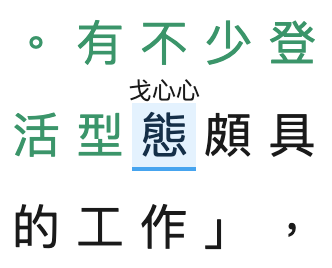
TypeChinese shows the Cangjie hint above the current character so you can guess first, then confirm the code.
Try this: open Traditional common character practice. When you cannot decompose a character, pause for 5 seconds. If you still cannot get it, reveal the hint, type the character, then immediately type the same character again.
Root charts matter, but reading charts will not make you fluent. You need to train the loop: see the character, decompose it, press the keys.
A better routine:
At the beginning, do not freeze on every difficult character until you fully solve it. Give yourself 5 seconds:
Cangjie memory comes from repeated encounters, not from solving every rule perfectly the first time.
Many learners feel like hints are cheating. At the beginner stage, hints are a training tool. The real problem is always looking at the hint without trying to remember first.
Suggested flow:
Single-character practice helps you learn roots, but real typing requires sentence rhythm. By the second week, start typing short sentences and paragraphs.
The outline below is the short version. Open the dedicated 4-week Cangjie practice plan when you want daily structure, checkpoints, and guidance on reducing hints.
Goal: see common roots and remember their keys.
Recommended page: 100 most common characters practice
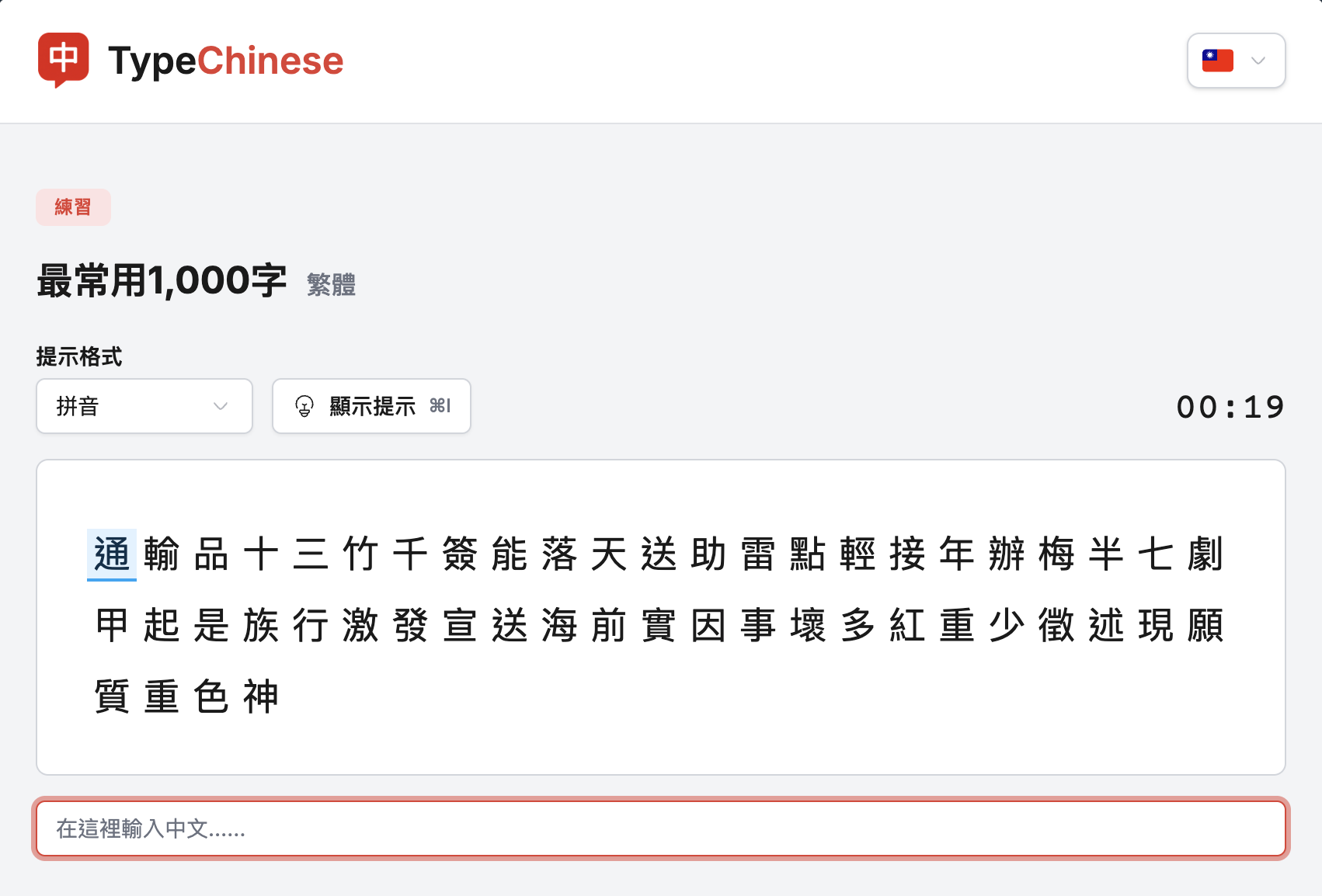
Start with common characters to build root and key memory before moving into full sentences.
Goal: start chaining decompositions together.
明, 林, 好, 休, and 時Goal: build continuous input rhythm.
Goal: handle full paragraphs with Cangjie.
Recommended page: Traditional Chinese newspaper typing practice
TypeChinese is not trying to make you memorize the entire Cangjie root chart. It helps you meet common characters repeatedly inside real text, so you learn while typing.
Use it like this:
After common characters feel familiar, switch to Traditional Chinese newspaper passages. Newspaper text gives you complete sentences and real vocabulary, which is closer to daily reading and work than isolated character lists.
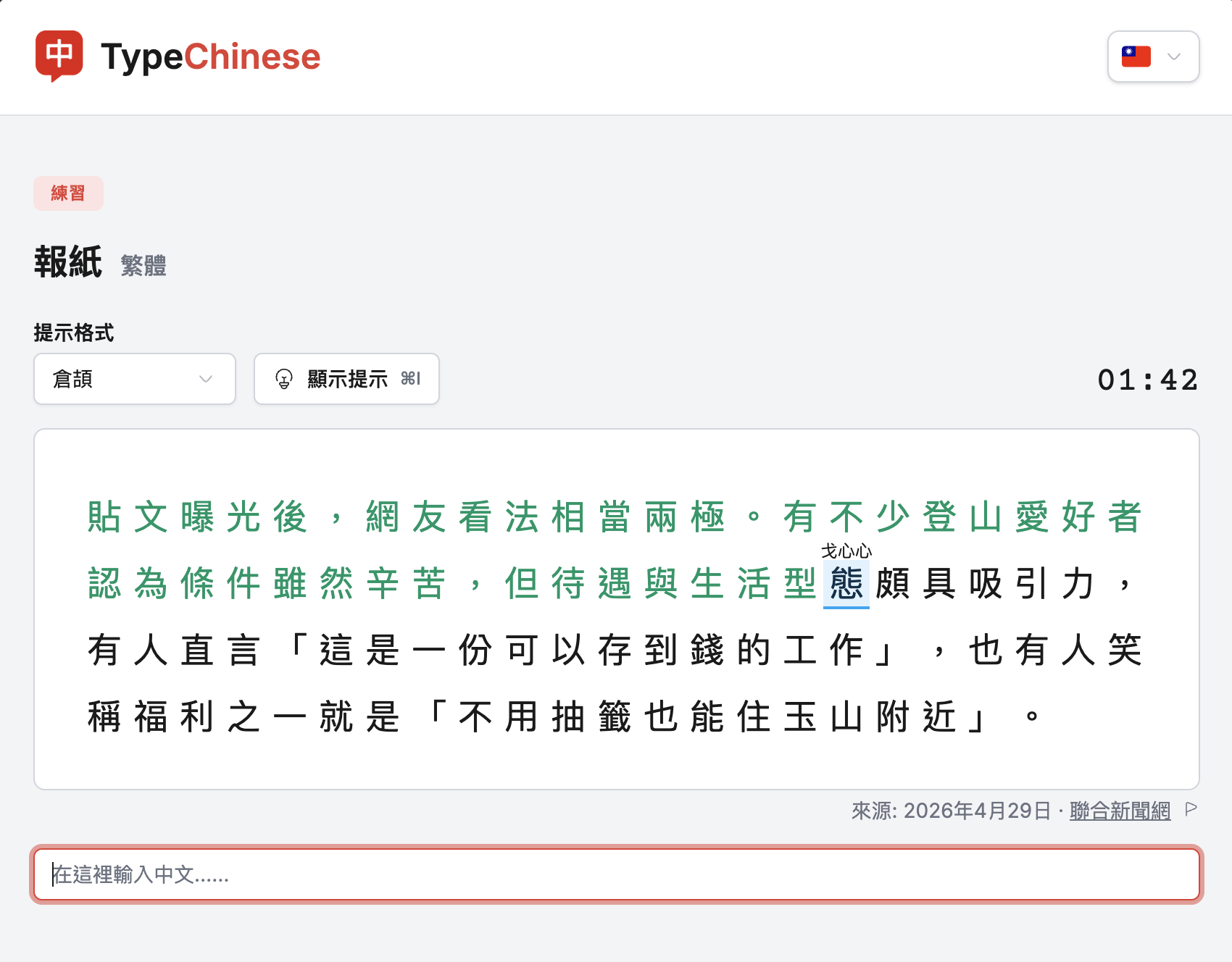
Once you move into newspaper passages, Cangjie hints help you place root memory inside real paragraphs.
It is harder than Pinyin, but it is not mysterious. The hardest part is the first two weeks, when you are building the link between roots and keys. After that, progress mostly comes from repeated practice with common characters.
If you practice 15-20 minutes a day, a rough timeline looks like this:
| Time | State |
|---|---|
| 1 week | You remember a batch of basic roots, but type slowly |
| 1 month | You can type common characters and short sentences |
| 3 months | You can type articles more smoothly |
| 6+ months | You start approaching practical speed |
Everyone moves at a different pace. The important question is not which day you become fast, but whether your hands touch real Chinese every day.
Sucheng, often called Quick, is a simplified version of Cangjie. It usually takes the first and last code, so the learning barrier is lower, but there are more duplicate codes and candidate choices. Full Cangjie is harder to learn, but more accurate and direct once fluent. See the complete Quick/Sucheng guide for a direct comparison.
If you have no background, you can learn what Sucheng is first. But if your goal is long-term computer typing ability in Chinese, learning full Cangjie gives you a more complete foundation.
Yes, if you type a lot of Traditional Chinese on a computer. Phone input and computer input are different situations. For Hong Kong, Taiwan, document work, and long-form writing, Cangjie still has real value.
If you are just starting, do not chase speed yet. Do one thing today: open common character practice, turn on Cangjie hints, and practice for 3 minutes.
When you begin measuring speed, compare consistent weekly sessions with the Chinese typing speed benchmark, not with a single personal record.
Then do another 3 minutes tomorrow.
Cangjie is not learned by understanding everything once. It is learned by turning roots into finger memory a little at a time.